
I love living an active lifestyle and being outdoors as much as I can. Before diving into my triathlon journey, I feel it’s important to understand what athletic endeavors I’ve had before coming to triathlon for the rest of this post to have the appropriate perspective. I’ll spare you the copious details of many years of sports participation and instead provide a simple, chronological list of activities. We begin way back when I was 7 years old and first began competitive swimming:
– Swimming
– Gymnastics
– Tennis
– Running
– Strength / weight training
– Yoga
– Obstacle course races
– Triathlon
This includes sports and activities I either competed in or dedicated significant time and energy into personal improvement. There are even more fun activities, such as hiking, kayaking, and pickleball-ing that I also do – and I am sure I have skipped some (like rock-climbing, I just remembered that one).
Triathlon Distances
There are a few different distances of swim, bike, and run available to athletes. For professional triathletes, there are additional race lengths but I’m not there…. yet? (Just kidding.) Below is a breakdown of the five main triathlon races. In case you’re new here, I have done all of these race distances!
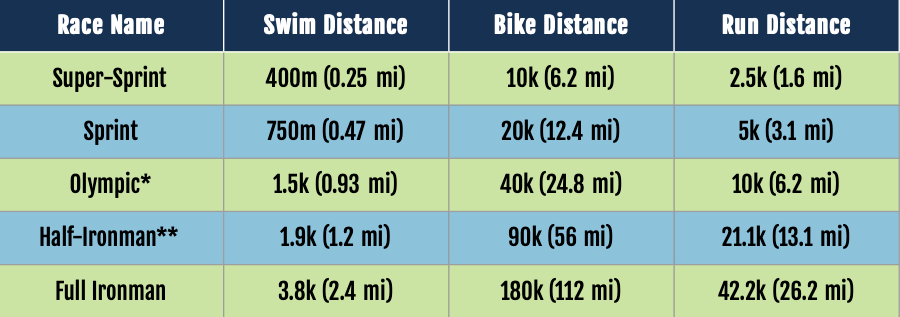
*Also known as the standard distance
**Also known as 70.3 (for total miles completed) or the middle distance
Check out this article to learn more about the training and considerations for these races if you are interested in taking one on yourself!
Why an Ironman?
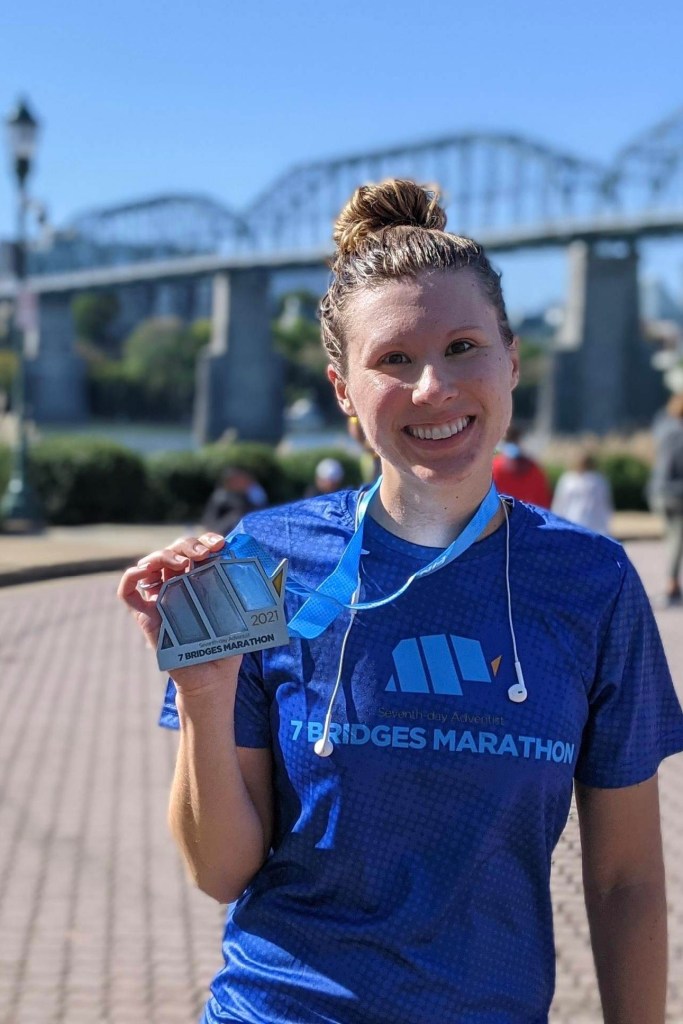
I began this post outlining the athletic pursuits throughout my life. What I haven’t shared is that there’s been a “progression”, if you will, in the intensity of what I’ve taken on. This really took form when I started running in college. Growing up a swimmer, I always joked I could really only excel athletically in the water. It took a while to not panic-breathe or get shin splints when I ran. Then I thought about running my first 5k, which my now-husband ran with me. I eventually gave a 10k race a try. Then I leveled up to a half-marathon, truly thinking a marathon was an impossible feat. After a few years doing obstacle course races that included tough obstacles AND a 12- to 14-mile run, I decided to train for a marathon. My sister-in-law did it with me, and it was really special to get to train and race with her.
Whatever felt impossible to me became my new goal.
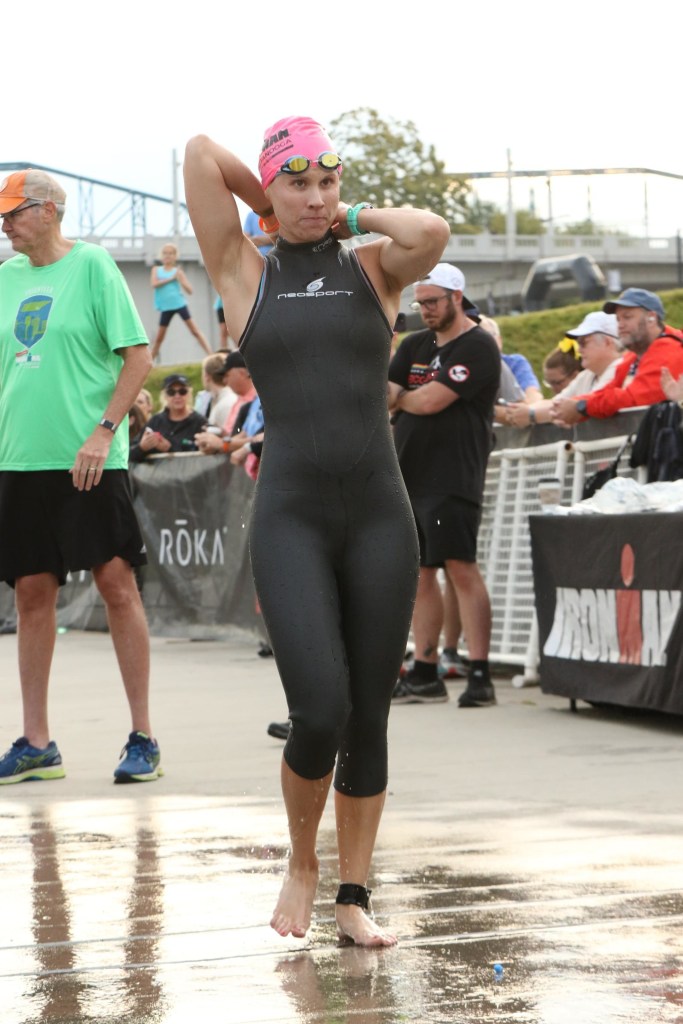
We completed that marathon in the fall of 2021 and, in January 2022, I signed up for an IRONMAN. Growing up seeing myself as a swimmer (and NOT a runner), running a 5k felt impossible. Then a 10k. Then a half marathon. Whatever the next progression of where I was that felt impossible to me became my new goal. I’d agree with you if you said that the jump from a marathon to an IRONMAN was a big one. It seems my progressions grew exponentially…
The Dataset and Visuals
While I have always tracked my workout stats in one way or another, I became serious about planning and capturing my training when I officially began training for my first full-distance IRONMAN triathlon in 2022. It started off with the non-glamorous basics – a note-taking app on my phone (Apple Notes, to be specific). It is the same app I am using to write this post – it’s simple and syncs across my devices. I created a file which I populated at the beginning of each week with my training plans across swim, bike, run, and cross-training – as if three sports isn’t enough already.
I captured lots of details from the basics like duration and distance covered, to heart rate trends, perceived exertion, and the specific workout I followed. There’s MANY blog post opportunities in all of that data. I decided to begin with the basics – exploring just how long and how far I’ve come across all my training and races over the past two years. I’ll kick things off with the summary statistics.
While training for and completing both the full and half-IRONMAN triathlons in Chattanooga (fall 2022 and spring 2023, respectively), I will be racing Augusta 70.3 this fall (2024).
Total Ironman training stats for 2 years by sport
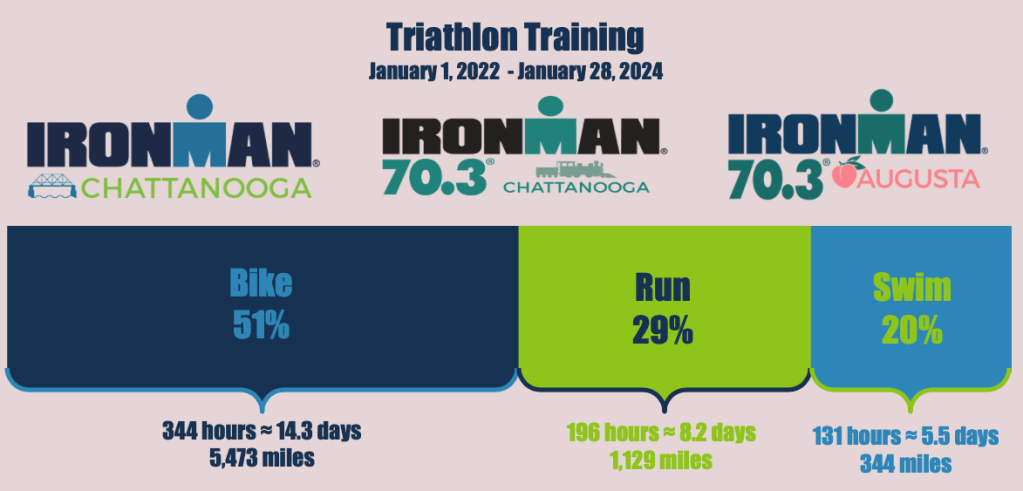
I have spent half of my time on the bike, both indoors and outside, getting ready for these races. Biking was (and still is) my weakest of the three sports… it’s also the longest portion of a triathlon. Yet another self-imposed challenge. Time on the bike, even if it’s easy, helps me become a better cyclist. I’m increasingly enjoying riding outside and have found some beautiful places to explore with my husband or my training buddies.
Almost 30 percent of my time has been spent pounding the pavement (read: running). In addition to the races I highlighted above, I also raced the 2023 IRONMAN Chattanooga as a relay with a friend. I did the swim (2.4 miles) and the run (a marathon), while my friend conquered the bike leg. Fun fact, the IRONMAN Chattanooga race course is 116 miles instead of 112 because of logistics getting into and out of the city. Bonus miles – because 112 isn’t enough (sarcasm, my friends).
I spent a fifth of my time swimming. It’s my favorite and strongest of the three sports and is a great balance to the impact of the other training I do. I would happily swim more, but there are only so many hours in a day and I very much enjoy eating, sleeping, and living my life otherwise.
The hourly breakdown for each discipline above is translated into non-stop 24-hour days and the corresponding total mileage. We can really only see the relative duration of training across swim, bike, and run in this view. So just how long is 344 hours of cycling?
Total Ironman training volume on a calendar
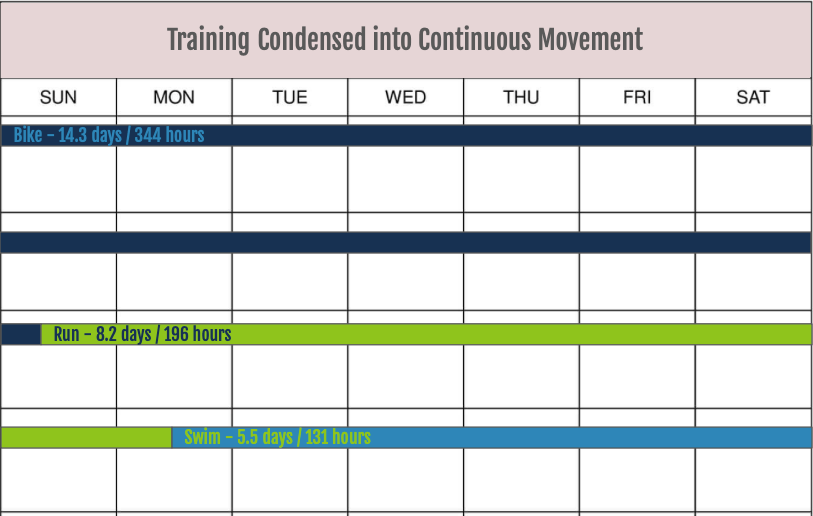
Let’s assume I were to condense my last two years of training into a calendar. If I moved in each sport continuously for 24-hours and immediately began the next sport, I would have been training or racing for a full 28 days (how fun when the math works out like that). By discipline, I can see how the hours translated into days, though I cannot fathom doing anything for 131 hours straight, no matter how much I love to swim!
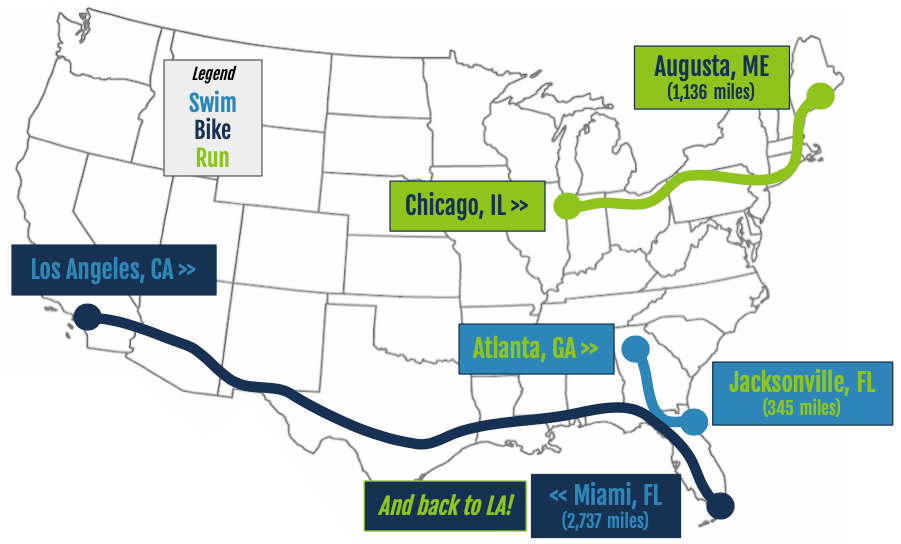
Even looking at a calendar, we can only experience time, not truly see it or touch it. In addition to my training duration, I looked at truly how far 345 miles of swimming would translate to on a map. I did the same for biking and running to get an appreciation for just how much work I have put in. Following the highways and roads across the U.S., swimming 345 miles equates to traveling south from Atlanta, Georgia to Jacksonville, Florida. My 1,129 miles of running is only 7 miles shy of traveling from Chicago, Illinois to Augusta, Maine. Most impressively, biking 5,473 miles equates to traveling from Los Angeles, California to Miami, Florida… AND BACK!
Total Ironman training by distance traveled across the U.S.
On the Horizon
I am continuing to track these data points and build out visuals that both help me assess my training progress and are cool to look at. I anticipate racing in six triathlons in 2024 (3 sprint-distance, 2 Olympic-distance, and one half IRONMAN) and am excited to see how I continue to learn and grow in the sport. I will be back soon to share more of the progress and the data visuals!
 Lauren Terschan